Integration by Partial Fractions
Integration by Partial Fractions allows us to express a rational function, i.e. f(x)/g(x), as a sum of simpler fractions. In the following examples, capital letters (A, B, C) denote constants to be determined. For each distinct linear factor (x-a) of g(x) we set up one partial fraction of the type A/(x-a). You will understand this idea, as well as how to determine these unknown constants, but studying the following example. We do one example with two different methods. Experiment with both and decide which one better suits you.
METHOD 1  METHOD 2 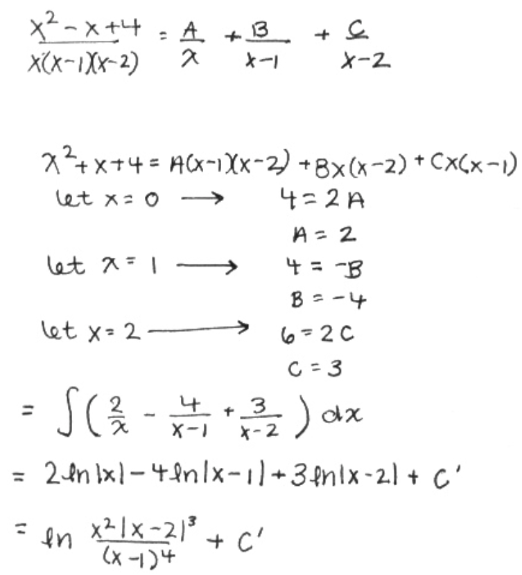 | STEPS • Set up partial fractions. Each denominator is a factor of the denominator of the original function. • Determine the lowest common denominator to write the expression without fractions. Then expand and combine like terms. • Isolate the coefficients of each degree. For example, group all of the x^2 terms together: (A+B+C)x^2. Then set this coefficient, A+B+C, equal to the coefficient of the x^2 term in the numerator of the original function, which is 1. Continue this step until you can set up a system and solve for A, B, and C. • Integrate your new function (which is equal to the original function) using Formula 4 and other Basic Formulas. • METHOD 2 has only one major difference. Instead of equating the coefficients, instead plug appropriate values in for x on both sides. For example, by plugging 0 in for x, we can get rid of B and C, thereby setting up a basic equal to solve for A. Repeat this method to solve for B and C. |
